Shared care in visual arts #3: Action, recovery, sanctions and opportunities for change
NICC and Flanders Arts Institute are organising a programme of three sessions in which we question what healthy collaboration in the visual arts can mean. We explore how working relationships can be designed in a clear, equal and caring way – focusing on clear agreements, shared responsibilities, mutual respect and access to support.
Shared care in visual arts #3
Conflict and inappropriate behaviour within the visual arts sector require a thoughtful and caring approach. The theme of the third session of this programme is action and recovery, inviting participants to consider different levels: the individual level, the organisation, and the sector as a whole. Each level has its own needs, responsibilities, and opportunities for change.
- Individual level: artists, art workers, and employees
When someone is confronted with a conflict or inappropriate behaviour, the question arises: How do you take action? Artists, independent art workers and employees of organisations need safe spaces, reliable confidants and accessible procedures that support them rather than causing additional pressure.
In addition, recovery plays an important role. What is recovery? For some, it means being heard sufficiently; for others, it is about time, guidance and new insights. Not everyone recovers completely, and that is not necessary: recovery is often not an end point, but a process in which you reorient yourself and discover what you need to move forward.
- Organisational level: responsibility and transition
Organisations bear an important responsibility in preventing and addressing conflicts. Instead of avoiding conflicts, organisations can turn them into learning opportunities. How can the organisation benefit from what has happened? This also means that organisations must be able to impose clear and proportionate sanctions as an essential part of responsibility, limitation and recovery.
- Sector and policy level: responsibility and vision
At the sector and policy level, the Flemish Reporting Centre, the Department of Culture and the support centres (like Flanders Arts Institute) play an important role. They not only contribute to the individual follow-up of reports, but also to the broader discussion on how the sector can transform itself.
For who?
For artists, (independent) art workers and staff of visual arts organisations.
Programme
09.45 Welcome
10.15 Introduction by Flanders Arts Institute, NICC and BOZAR
10.30 Presentation by the Flemish Reporting Centre for Transgressive Behaviour
10.50 Presentation by Aline Bauwens on action and mediation
11.10 Presentation by Nikol Wellens (Flanders Arts Institute) on addressing injustice and avoid harm
11.30 Group discussion
13.00 Lunch
14.00 Presentation of a case study: argos
14.20 Discussion on recovery and transition with Dette van Zeeland
15:00 Workshop with The School of Love
16.00 Conclusion and future prospects
16.30 End
Practical
Tuesday 27 January from 10am to 4.30pm at BOZAR (Brussels).
The conversation will be held in English.
Register now
Register via the button at the top right.
Speakers
-
The Flemish Reporting Centre is a point of contact for anyone who has experienced inappropriate behaviour in an organisation or knows someone who has. The reporting centre has a dual mission: to receive reports and support the reporter in obtaining an appropriate response, and to monitor and map reports.
-
As an expert in workplace conflicts, Aline Bauwens helps organisations and professionals with collaboration issues to gain a clear view of the path to the best possible solution for the difficult situation they find themselves in. To this end, she combines 15 years of academic research experience and practical experience in more than 250 organisations with a sharp, solution-oriented perspective. She offers her expertise in the role of mediator, advisor, and external confidential advisor.
-
As a researcher at Flanders Arts Institute, Nikol Wellens focuses on the achievements and needs of the artistic practices of individuals and organisations. She works on themes such as fair practices, sustainability, livelihood security, quality assessment, and cross-sectoral working.
-
As a trainer and organisational coach, Dette van Zeeland guides organisations to become a flowing system that facilitates shared leadership, embraces a culture of trust and constructiveness, and deals with change in an agile manner. Her expertise lies, among other things, in setting up an organisational model that enables plurality, feedback and equality.
-
After a tumultuous organisational period, argos evaluates a series of conflict resolution initiatives and their impact in the workplace. Having also dedicated an artistic programme and a publication to change in art institutions, it is now time to ask the pivotal questions: what worked, what didn’t and when can we actually speak of ‘recovery’?
-
School Of Love (SOL) is a Brussels-based collective whose members come from diverse artistic backgrounds, including performance, dance, visual arts, education, participatory practices, anthropology, and music. They develop collective artistic practices that invite people to explore ways of being and acting together, approaching love as a mode of engagement in social and political life rather than only a personal matter.
More information
Do you need more information about this session, or do you have questions about the trajectory? Contact our colleague Lissa.
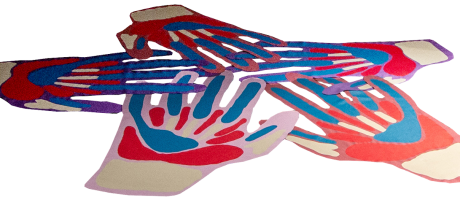
Image: Laurie Charles, Hands, 2019.
In the framework of the CARE-Culture for mental health project, co-funded by the European Union. Views and opinions expressed are however those of the author(s) only and do not necessarily reflect those of the European Union. Neither the European Union nor the granting authority can be held responsible for them.